
The Hidden Cost of Inaccurate Pipettes
Why Pipette Accuracy Matters
By Kent Koeman, Director of Pipette Sales & Marketing, Pipette Calibration Specialist

Most laboratory professionals understand that pipette accuracy affects data quality. What is often overlooked is the true financial impact of inaccurate pipettes. A pipette operating outside acceptable tolerance limits does more than create minor measurement errors. If left unchecked, it can trigger a cascade of hidden costs that affect productivity, compliance, research outcomes, and laboratory budgets.
Whether you're conducting PCR assays, ELISA testing, cell culture work, pharmaceutical development, or academic research, even small deviations in volume can have significant downstream consequences.
The good news? Regular laboratory pipette calibration and proactive pipette management programs can minimize these risks while delivering substantial return on investment.
Quantifying the Hidden Costs of Pipette Inaccuracy
The costs associated with inaccurate pipettes rarely appear as a line item on a budget report. Instead, they emerge through wasted resources, repeated work, delayed projects, and compromised data quality.
Let's examine the most significant hidden costs.
1. Rework and Repeat Experiments
One of the most immediate consequences of poor pipette accuracy is invalid experimental results.
When incorrect volumes are dispensed, researchers may have to repeat entire assays to verify questionable findings. This creates additional expenses through:
- Additional pipette tips, plates, and tubes
- Additional labor hours
- Delayed project timelines
In sensitive applications such as PCR, ELISA, and cell-based assays, even small volume deviations can invalidate entire datasets.
Hidden Cost Impact
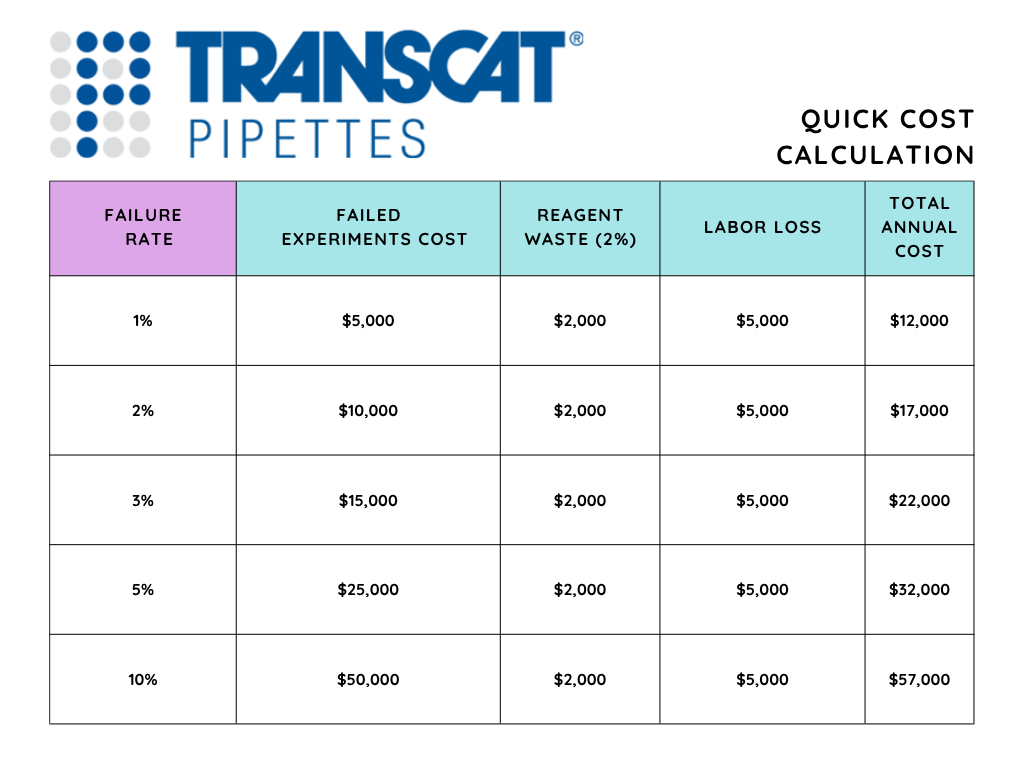
A single failed experiment may seem insignificant, but repeated failures can quickly add up to tens of thousands of dollars annually.
2. Wasted Reagents and Consumables
Reagents often represent one of the largest expenditures in laboratory operations.
When pipettes consistently over-dispense or under-dispense volumes, laboratories experience:
- Excess reagent consumption
- Failed reactions requiring replacement materials
- Increased use of consumables
- Reduced utilization of expensive kits
This issue becomes particularly costly when working with:
- Enzymes
- Antibodies
- Diagnostic kits
- Rare biological samples
- Specialty research reagents
For high-throughput laboratories, a small percentage of waste can translate into thousands of dollars of unnecessary spending every year.
3. Reduced Laboratory Productivity
When experimental results become inconsistent, scientists invest valuable time troubleshooting issues rather than advancing research.
Researchers may spend hours:
- Reviewing protocols
- Verifying reagent preparation
- Rechecking calculations
- Conducting additional quality checks
- Investigating inconsistent data
In some cases, the root cause is simply an inaccurate pipette.
Even 15 minutes of troubleshooting per scientist each day can accumulate into hundreds of lost labor hours annually.
4. Data Integrity and Quality Risks
Reliable science depends on reproducibility.
Inaccurate pipetting introduces variability into experimental workflows, resulting in:
- Higher data variability
- Reduced reproducibility
- Lower statistical confidence
- More frequent quality control failures
Poor data quality can lead to:
- Delayed publications
- Additional validation studies
- Rejected research findings
- Regulatory scrutiny
For organizations involved in regulated testing, product development, or clinical research, compromised data integrity can have significant business implications.

5. Compliance and Regulatory Risks
Many laboratories must comply with quality standards and regulatory requirements.
Organizations operating under:
- GLP (Good Laboratory Practice)
- GMP (Good Manufacturing Practice)
- ISO quality systems
- ISO 8655 pipette calibration requirements
must demonstrate that measurement equipment is properly maintained and calibrated.
An inaccurate or improperly maintained pipette can contribute to:
- Audit observations
- Corrective action requirements
- Regulatory findings
- Retesting costs
- Invalidated work
In regulated environments, these risks often represent one of the most expensive consequences of poor pipette management.
6. Loss of Irreplaceable Samples
Not all laboratory samples can be replaced.
Incorrect dispensing volumes can compromise:
- Patient-derived specimens
- Clinical samples
- Environmental samples
- Long-term studies
- Limited research materials

The cost extends beyond financial loss. In some situations, the sample itself is irreplaceable, making the impact permanent.
7. Staff Morale and Scientific Confidence
Repeated experimental failure can have a surprisingly large effect on laboratory culture.
Scientists who consistently encounter inconsistent results may experience:
- Frustration
- Reduced confidence in methodologies
- Lower engagement
- Increased turnover risk
While difficult to quantify, these factors influence overall operational efficiency and team performance.
8. Equipment Wear and Improper Use
Laboratories that neglect regular pipette calibration often experience other equipment-related issues as well.
Poor maintenance practices may contribute to:
- Increased repairs
- Seal and piston wear
- Reduced instrument lifespan
- Unexpected downtime
Preventive maintenance and routine calibration programs help extend pipette performance while reducing repair costs.
9. Opportunity Cost
Perhaps the most overlooked expense is opportunity cost.
Every hour spent investigating avoidable errors is an hour that cannot be spent on:
- New experiments
- Product development
- Publications
- Process improvement
- Innovation initiatives
For competitive research organizations, these missed opportunities can significantly impact long-term success.
Annual Cost Impact of Inaccurate Pipettes
Many laboratories must comply with quality standards and regulatory requirements.
Organizations operating under:
- GLP (Good Laboratory Practice)
- GMP (Good Manufacturing Practice)
- ISO quality systems
- ISO 8655 pipette calibration requirements
must demonstrate that measurement equipment is properly maintained and calibrated.
An inaccurate or improperly maintained pipette can contribute to:
- Audit observations
- Corrective action requirements
- Regulatory findings
- Retesting costs
- Invalidated work
In regulated environments, these risks often represent one of the most expensive consequences of poor pipette management.